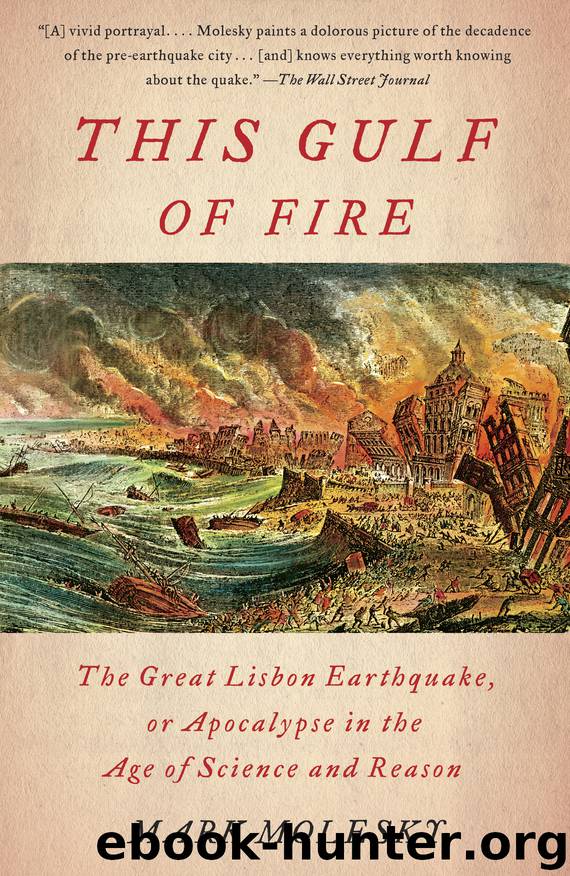
This Gulf of Fire by Mark Molesky
Author:Mark Molesky
Language: eng
Format: epub
Publisher: Knopf Doubleday Publishing Group
Published: 2015-11-03T05:00:00+00:00
CHAPTER EIGHT
“A Chaos of Stones”
All the pomp has ended, ’twas fleeting;
No more than a sad memory
Of the famous city that someday
Only the crystals of the Tagus will enrich.
—DOMINGOS DOS REYS,
“POEM ON THE LAMENTABLE EARTHQUAKE” (1756)
DAMAGE ASSESSMENT
On February 19, 1756, more than ten weeks after the disaster, Monsignor Acciaiuoli confided to Pope Benedict XIV about the state of the Portuguese capital. “I ask Your Holiness to believe that it is much worse than what I have previously mentioned, despite the fact that there are those who would like to make it appear less.”1 Few outside the government would have disputed the nuncio’s assessment, for in February 1756 central Lisbon was little more than a vast, yawning ruin. Its commercial and political core had been burned beyond recognition and much else had been shaken to the ground or damaged. The densely populated Baixa had borne the full brunt of the inferno as it had the earthquake—but other areas had suffered as well.2 “The fire reduced to ashes a large portion of the old city and a large portion of the new,” wrote Moreira de Mendonça. It “completely destroyed the neighborhoods of the Ribeira, the Rua Nova [dos Mercadores], and the Rossio, and the largest parts of the neighborhoods of the Remoulares, the Bairro Alto, the Limoeira, and the Alfama, which,” he added, “are the richest and most populous seven neighborhoods of the twelve that make up the city.”3 In Father Portal’s view, it destroyed “the heart of the city.”4
While the earthquake had set the destruction in motion, it was “the fourth element [fire],” recalled one eyewitness, “that caused the most consternation, and which, without exaggeration, burned the largest and best part of Lisbon.”5 “The fire,” affirmed Mr. Braddock, “may be said to have destroyed the whole city, at least everything that was grand or valuable in it.”6 In the opinion of one Portuguese priest, it was the disaster’s “greatest thief.”7 Abraham Castres estimated that the “Conflagration” did “ten times more Mischief than the Earthquake itself,” a reckoning that was repeated in numerous broadsheets and newspapers at the time.8
On the other hand, if no fires had broken out, some sections of the Baixa would have suffered only moderate damage, and many treasures would have been recovered from the rubble. On the New Street of the Merchants (Rua Nova dos Mercadores), “only a few houses initially fell,” wrote Father Portal. But after the fire swept through the Baixa, it “was completely reduced to ashes.”9 It burned “those [buildings] that had fallen as well as those that still stood,” wrote another priest. It was “the cruel executioner of the people of Lisbon,” a “barbarous element,” a “tyranny.”10
In all, an area comprising more than one and a half square kilometers or 1,500 by 1,000 meters was destroyed by the blaze. It devoured both sides of the Rua Nova dos Mercadores, according to a priest, and all the riches possessed by those who lived there, including “the whole of the Rua do Ourives do Ouro e Prata…the
Download
This site does not store any files on its server. We only index and link to content provided by other sites. Please contact the content providers to delete copyright contents if any and email us, we'll remove relevant links or contents immediately.
Man-made Catastrophes and Risk Information Concealment by Dmitry Chernov & Didier Sornette(6144)
The Revenge of Geography: What the Map Tells Us About Coming Conflicts and the Battle Against Fate by Kaplan Robert D(4108)
Zero Waste Home by Bea Johnson(3888)
COSMOS by Carl Sagan(3671)
Good by S. Walden(3612)
In a Sunburned Country by Bill Bryson(3587)
The Fate of Rome: Climate, Disease, and the End of an Empire (The Princeton History of the Ancient World) by Kyle Harper(3091)
A Wilder Time by William E. Glassley(2899)
Camino Island by John Grisham(2824)
Organic Mushroom Farming and Mycoremediation by Tradd Cotter(2721)
The Ogre by Doug Scott(2716)
Energy Myths and Realities by Vaclav Smil(2535)
Human Dynamics Research in Smart and Connected Communities by Shih-Lung Shaw & Daniel Sui(2520)
The Traveler's Gift by Andy Andrews(2493)
9781803241661-PYTHON FOR ARCGIS PRO by Unknown(2404)
Inside the Middle East by Avi Melamed(2389)
Birds of New Guinea by Pratt Thane K.; Beehler Bruce M.; Anderton John C(2277)
A History of Warfare by John Keegan(2272)
And the Band Played On by Randy Shilts(2245)
